
How to Check Rutledge Criminal History
Start with the event, not a broad name search. A Rutledge call, report, arrest, jail intake, and court judgment can sit in different files even when they concern the same person. The official service-delivery agreement assigns primary law enforcement in Rutledge to the Morgan County Sheriff. That fact sets the first route, but it does not turn the Sheriff into the keeper of every later court paper.
- Confirm that the event occurred in Rutledge and identify the agency shown on any citation, report, or release paper.
- Ask the Morgan County Sheriff for an existing incident or arrest record through the county open-records form, by phone, fax, email, or at the counter.
- For present custody, call the Adult Detention Center at 706-342-2164 because no public county inmate roster was verified.
- Use the charge paperwork to find Superior, Magistrate, Probate, or another receiving court, then ask its clerk for the disposition.
- Use Georgia Felon Search only for its narrow statewide view of reported Georgia felony convictions, not as a substitute for Rutledge reports or court files.
Why Rutledge Police Records Are County Records
Rutledge does not operate a police department. Morgan County Sheriff is the primary law-enforcement provider under the official city and county service arrangement. A request should therefore name the Rutledge location, date, people involved, and any incident number, then identify the Sheriff branch of the county form. This is a local distinction with a real effect: sending a police-report request to Rutledge City Hall is unlikely to reach the custodian that investigated the event.
Sheriff Administration is at 1380 Monticello Road, Madison, Georgia 30650. The main number is 706-342-1507, the fax is 706-342-4561, and the county names Kim Cox at ORR@morgancountyga.gov as the open-records custodian. City Hall can still help with Rutledge government questions. It should not be described as a police records desk.
The Sheriff route also depends on the type of record sought. Patrol or investigators may hold the narrative from a call in Rutledge. Administration processes warrants issued by the courts and routes public-record requests. The detention unit holds intake and current custody data. A requester who asks one unit for a complete history may receive only the portion that unit owns. Naming the event, date, Rutledge address, deputy, and desired record gives staff a much clearer search target.
The county form lets a requester mark that the matter pertains to the Sheriff and then enter incident-specific facts. It also offers access-only or copy-only choices. The general county notice gives a three-business-day response framework, but that is a response deadline, not a promise that a large file will be produced at once. Black-and-white letter-size county copies are listed at ten cents per page, while no separate Sheriff report-copy fee was located. Confirm any cost before ordering.
Rutledge Police Department Records
There is no Rutledge Police Department records unit, report portal, blotter, or police app to search. That absence is important. It prevents a reader from wasting time looking for a city service that official research did not verify. The practical local records unit is Morgan County Sheriff, whose divisions separate patrol, investigations, warrants, detention, and court services.
A patrol report and a jail booking are not the same record. Patrol or investigators may hold the incident narrative. Administration processes warrants. Detention creates the custody entry. Once charges are filed, the receiving court holds the docket and final order. A narrow request directed to the right unit is more useful than asking City Hall or the Sheriff to compile a complete history from records owned by several offices.
Rutledge Sheriff Record Request Fields
The county’s official open-records form is the documented online path for a Rutledge Sheriff record. Select yes when the request pertains to the Sheriff. The form asks for enough event detail to identify an existing file, while allowing the requester to choose inspection or a copy.
| Required contact details | Request date, first and last name, mailing address, city, state, ZIP, phone, email, signature, and signature date |
|---|---|
| Incident details | Incident number, incident date, reporter or driver, deputy, and Rutledge location when known |
| Record description | A specific account of the existing report, log, or other record sought |
| Delivery choice | Access only or copy only |
| Portal controls | Continue, Go Back, Submit, and reCAPTCHA; signing in is optional |
Georgia law does not require the agency to create a new compilation. A dated request for a named incident report is more precise than a request for “all criminal history.”
Arrests and Bookings in Rutledge
Rutledge has no city holding facility documented in the official sources. A person arrested in Rutledge is routed into the Morgan County detention system. Current custody should be checked by calling 706-342-2164. No official county inmate roster, public booking blotter, or Rutledge arrest feed was found, so a web search cannot replace that call.
The jail entry shows custody and intake-related facts. It does not prove guilt and does not reveal the final result of the charge. The incident report stays with the investigating agency, while the court file records hearings, pleas, judgment, and sentence. For more county-level detail about these stages, the Morgan County arrest history page separates the official channels without republishing names or booking photographs.
Rutledge Booking Status and Case Outcome
Use two contacts when the question spans custody and outcome. The detention center can confirm whether someone is currently held, but a release does not mean a charge was dismissed. The correct court clerk can identify whether a case was filed and what disposition was entered. Ask for the judgment or disposition and sentence when that is the goal.
Superior Court is the felony anchor. Its clerk is at 384 Hancock Street in Madison and can be reached at 706-342-3605 or info@morganclerkofcourt.com, Monday through Friday from 9:00 a.m. to 5:00 p.m. Magistrate Court uses 149 East Jefferson Street and 706-342-3088. Probate Court, also at 149 East Jefferson Street, publishes traffic and game-and-fish jurisdiction and can be reached at 706-343-6500.
Rutledge Municipal Court Records
No active Rutledge municipal court, clerk, calendar, docket, or case portal was verified on official city resources. The safe conclusion is not that a court was abolished. It is that a current city court channel could not be confirmed. Check the citation or charging papers, then contact the named county clerk rather than inventing a Rutledge docket.
| Court Name | No verified active Rutledge Municipal Court |
|---|---|
| Case Types Heard | No current Rutledge municipal jurisdiction or operating schedule was verified |
| Case Lookup Channel | Use the court named on the papers; call Rutledge City Hall only to clarify municipal administration |
| What the File Shows | The receiving clerk may hold charges, docket events, orders, disposition, and sentence |
| Copies and Fees | Ask the actual clerk; no Rutledge municipal copy fee was located |
Rutledge City Hall Record Limits
Rutledge City Hall is a municipal administration contact, not a substitute police or court counter. The city receives mail at P.O. Box 277, Rutledge, GA 30663. Its number is 706-557-2223, fax is 706-557-8070, and general email is rutledgecityof@bellsouth.net. Regular hours are Monday, Tuesday, Thursday, and Friday from 8:00 a.m. to 4:30 p.m. Wednesday hours end at noon.
Those short Wednesday hours matter when a person wants to clarify whether a paper came from the city or county. Call before traveling, especially on Wednesday, and ask only for the municipal fact City Hall can verify. An incident narrative should still go to the Sheriff. Current confinement belongs with the jail, and a filed charge belongs with the court named on the citation or bond paper. City staff should not be expected to assemble those separate records into one criminal-history report.
The Georgia Municipal Association profile for Rutledge provides the source view used for the city image below. It helps identify the municipal counter without implying that Rutledge runs a police department or active court.
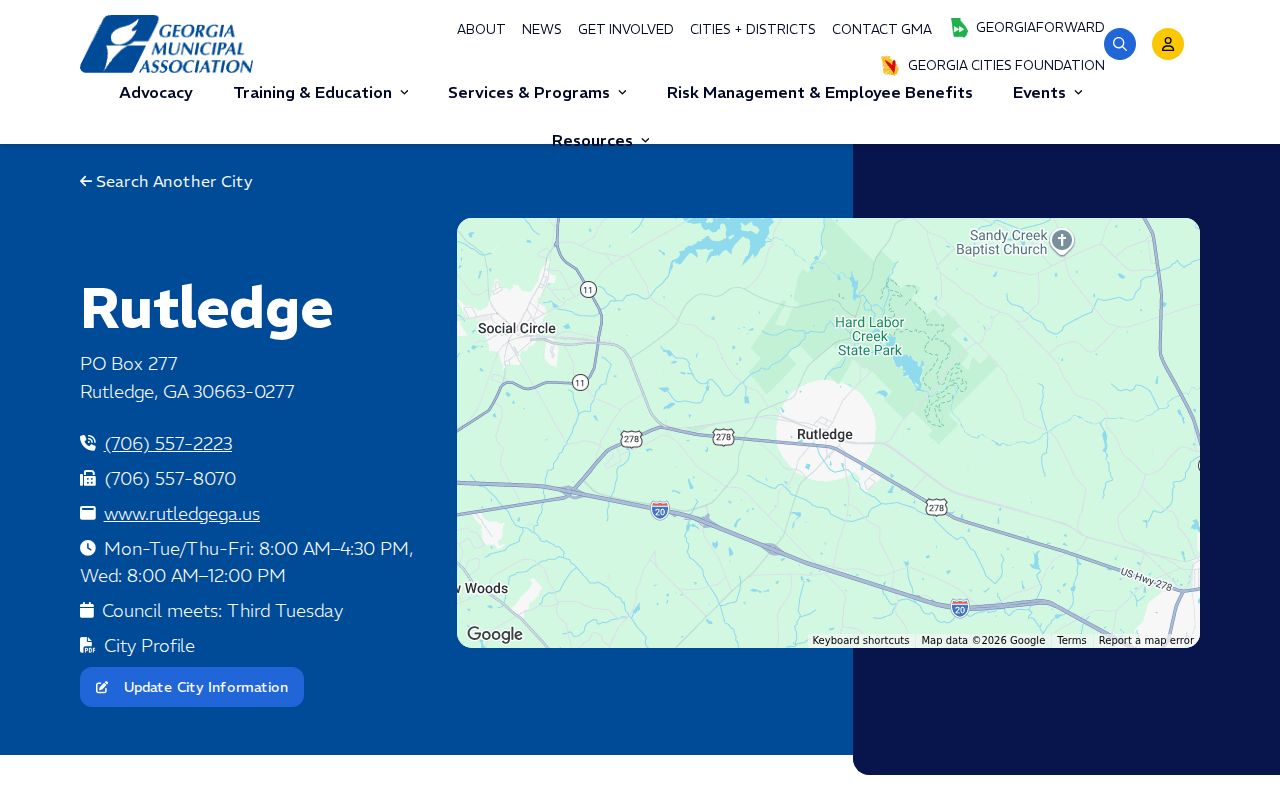
The profile places Rutledge government in local context, while criminal justice requests still follow the Sheriff, jail, and receiving court.
Where Rutledge Criminal Records End Up
A Rutledge event can create several linked records. Sheriff patrol or investigations creates the report. Detention creates a booking entry if the person is confined. A prosecutor and court create the filed charge and disposition. Georgia justice agencies later transmit eligible identifying and outcome data to the Georgia Bureau of Investigation’s Georgia Crime Information Center.
Record flow: Morgan County Sheriff in Rutledge › Morgan County Courts › GBI Georgia Crime Information Center
The sequence explains why a recent arrest may appear before an outcome and why a name-only state result may not answer a local case question. Georgia uses the Offender Tracking Number to connect an arrest cycle to later disposition reporting. The court remains the best source for adjudication, and fingerprints remain the sure way to confirm identity.
Rutledge Records Since 1871
Rutledge was incorporated in 1871. Current city messaging stresses controlled, smart growth and preservation of its “Small but Special” character. That civic identity is useful local context, but it does not create a separate city justice system. The municipality’s size and county policing arrangement make routing more important than searching for a broad city database.
The common-vintage population used to rank Morgan County’s city pages is 871. County crime totals must not be assigned to those Rutledge residents as if they were city counts. No official Rutledge-specific crime table was found. County data may describe the wider law-enforcement setting, but it cannot establish the number or type of offenses within Rutledge itself.
Which Court Holds Rutledge Charges
Read the charge level and issuing paperwork. A felony generally routes to Superior Court. Probate Court publishes traffic and game-and-fish jurisdiction. Magistrate Court has its own counter and files. A state patrol stop or another agency event may also change the first report custodian, even when the location is Rutledge.
No active Rutledge municipal court, clerk, calendar, or portal was confirmed in official city material. That finding makes the charging paper crucial. It does not prove that every Rutledge event goes to the same county counter. The issuing agency, charge type, and court printed on the document should control the next call. If the paper is missing, begin with the likely clerk and give the full name, event date, Rutledge location, and charge description.
The official Morgan case-search endpoint is a reasonable first try, but its interface did not render during research. Do not assume it offers complete remote coverage. If it fails, contact the clerk with the exact case number. A correctly spelled name and approximate year may help when the number is unknown. Older material may require a staffed counter search.
Public Access Rules for Rutledge Records
Public access depends on the record and its custodian. The Georgia Open Records Act covers existing public agency records, sets a three-business-day response framework, and permits lawful search, redaction, and production costs. It does not promise that a large request will be fully produced in three days. Active investigative facts, juvenile material, medical data, protected identifiers, and restricted records may be withheld.
Key Statutes:
Georgia Open Records Act, O.C.G.A. §50-18-70 et seq. gives access to existing public records while allowing specific exemptions and reasonable production steps.
O.C.G.A. §35-3-34 governs criminal-history dissemination and permits a narrow public felony-conviction name check.
O.C.G.A. §35-3-37 governs inspection, correction, privacy, and eligible record restriction.
A denial should identify legal authority. Ask the office that owns the disputed fact to correct it, then provide source documents to GCIC if the statewide history is wrong.