
How to Check Criminal History in Madison
Start with the office that created the record. Madison Police is the right first stop for an incident or accident investigated by a city officer. The Municipal Court clerk is the source for a city citation, appearance date, sentencing order, payment record, or sentence condition. If a person entered custody, the Morgan County Sheriff Adult Detention Center owns the booking layer. Felony filings and dispositions move to Superior Court rather than remaining in the city court.
A five-part check keeps these layers distinct:
- Confirm whether Madison Police investigated the event by reading the citation, report number, or other paperwork.
- Request the city incident or accident report through the police records channel.
- Ask the Madison Municipal Court clerk about city charges, appearance status, and the judgment.
- Check Morgan County custody and court offices when the arrest produced a jail booking or felony case.
- Use an official Georgia repository channel only when the narrower statewide record layer answers the question.
The broader Morgan County criminal history overview explains county and state checks without turning the city route into a statewide search. A name alone is weak evidence. Match dates, birth data, citation or case numbers, and the agency before treating records as belonging to the same person.
Madison Police Report Channels
The official Madison reports and records page shows that city criminal records use different channels by record type.
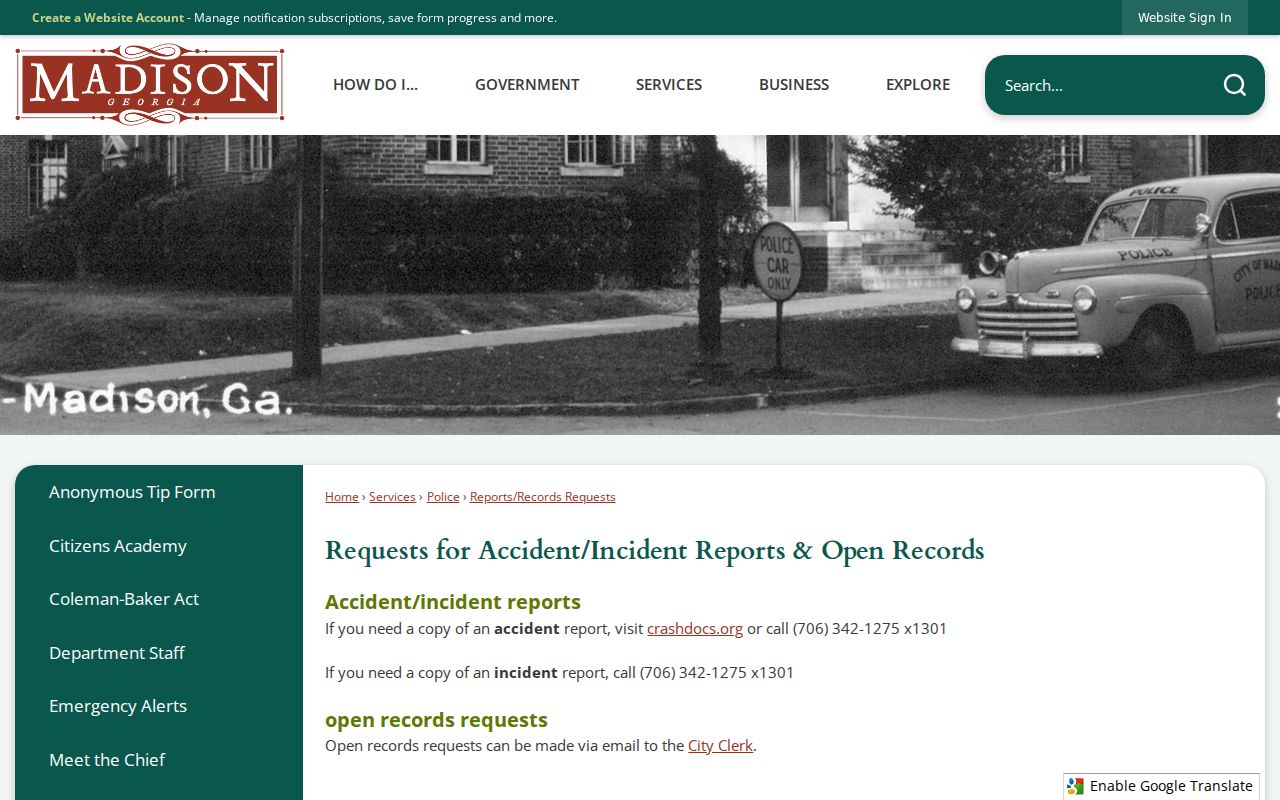
Accident reports route through CrashDocs or the records clerk, while incident reports begin by calling 706-342-1275 extension 1301. General open-records requests go by email to the City Clerk. The page does not publish a report fee, identification rule, fixed turnaround, or downloadable fielded request form, so ask the custodian to state any cost or proof requirement before ordering.
Give a narrow description: incident number if known, event date, location, involved person, and the exact document sought. An incident report is not a citywide criminal history compilation. It describes one reported event and may contain investigative detail that is redacted or withheld when an exemption applies.
The Madison Police Department
Madison Police serves from 160 N. Main Street, Suite 300, Madison, GA 30650. The public counter is open Monday through Friday from 8:00 a.m. to 5:00 p.m. The main number is 706-342-1275, the fax number is 706-342-2890, and emergencies belong with 911. Administration, patrol, and investigation are distinct divisions, which helps explain why a caller may be routed after describing a record.
The police building is also where the Municipal Court clerk works, but it is not where every Madison criminal record ends. A report stays with the investigating agency. A booking stays with the county jail. A filed felony case belongs with the Superior Court clerk. Ask for the record by type rather than requesting every criminal record tied to a name.
Note: Georgia State Patrol or another agency may own a report from an event inside Madison, so verify the badge or citation first.
Madison Crime Counts in Context
The city’s police transparency page supplies context for records created during 2025.
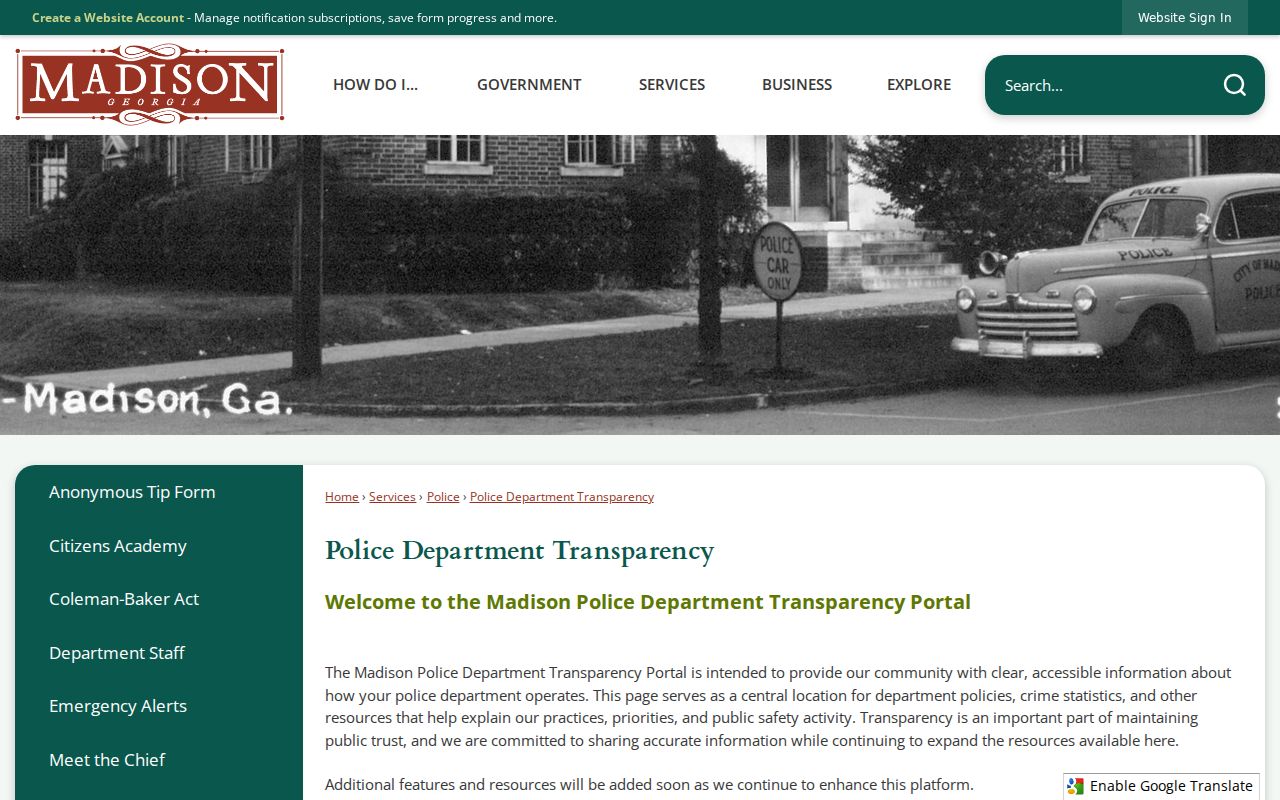
Madison Police reported 12,073 calls for service, a 25.3 percent rise from 9,633. Incident reports rose 8.9 percent to 549. Yet total reported crimes fell 11.1 percent to 248, and property crime fell 26.8 percent to 131. Violent crime moved from 42 to 44. These measures can move in different directions because calls include service needs beyond crimes, and enforcement or reporting patterns shape how many records appear.
These are Madison city figures, not Morgan County totals. They do not measure crime in Rutledge, Bostwick, Buckhead, or unincorporated areas. A trend also cannot establish what happened in one named case. Use the police report and court disposition for that task.
Arrests and Bookings in Madison
Madison does not publish a city holding facility. When Madison Police makes a custodial arrest, confinement flows to the Morgan County Sheriff Adult Detention Center at 1380 Monticello Road. Current custody questions go to the jail at 706-342-2164. The city officer’s report remains with Madison Police even though the jail creates the intake and release record.
That split matters. The police report may contain the event narrative, named roles, investigative steps, and listed charges. The booking record documents intake, identifiers, custody status, and release data. Neither proves guilt. The receiving court later records the filed accusation, plea, dismissal, judgment, and sentence. For deeper county booking detail, use the dedicated Morgan County arrest history route.
There is no verified public Morgan County inmate roster, city booking blotter, or active-warrant portal. Call the jail for present custody, then contact the record owner. Do not infer dismissal from release, and do not infer a conviction from a booking.
One Clerk, Two Madison Buildings
A common Madison records mistake is going to the right court but the wrong building. Municipal Court clerk Katie Dunworth works at the Police Station at 160 N. Main Street and can be reached at 706-752-7942. Court convenes at 9:00 a.m. in the lower courtroom at 149 E. Jefferson Street. Administrative records and the hearing room therefore occupy separate sites.
The official court appearance instructions identify the courthouse and courtroom rules.
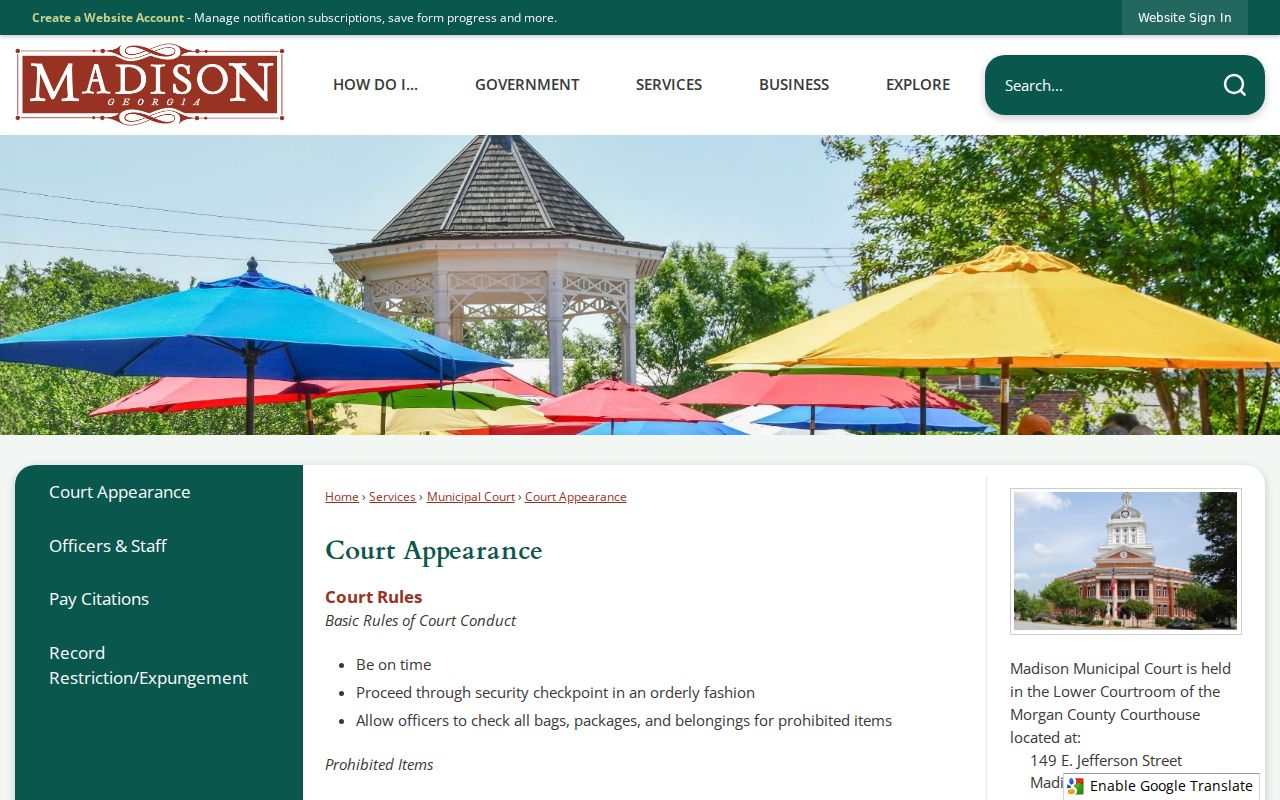
Visitors should permit bag checks. Weapons, food, beverages, gum, tobacco, and unapproved recording devices are barred. Phones must be silent, and calls are not allowed in the courtroom. Free language interpreters may be requested at the first appearance or beforehand. Call the clerk before travel when the goal is a copy rather than a hearing.
Madison Municipal Court Records
Madison Municipal Court is a limited, nonjury court. It hears city traffic and ordinance misdemeanors, specified state misdemeanors, its probation violations, and public-nuisance matters within its published authority. Examples include shoplifting, public intoxication, disorderly conduct, certain underage alcohol offenses, and possession of less than one ounce of marijuana. Adult jurisdiction begins at 17; cases involving younger defendants route to Juvenile Court.
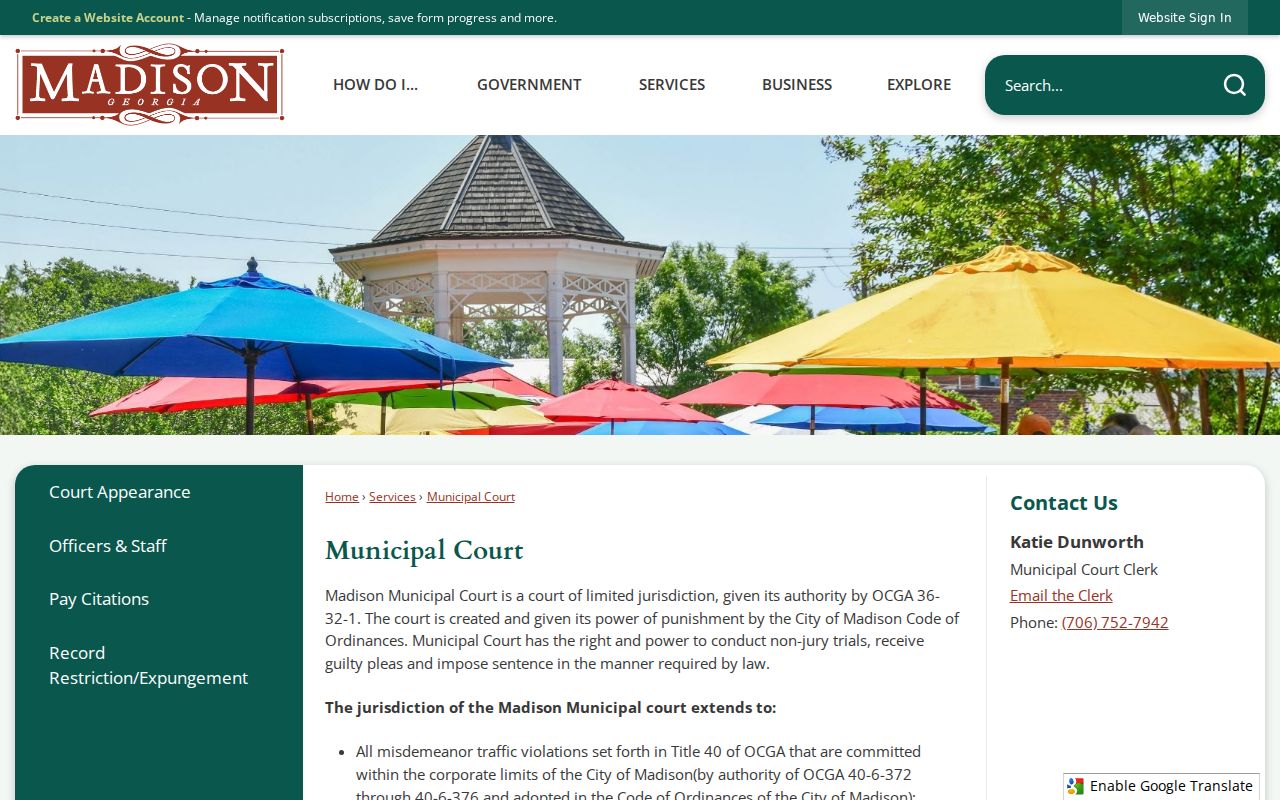
The clerk’s file is the local source for the court outcome. Its contents differ from a police report:
| Court Name | Madison Municipal Court, a limited nonjury city court |
|---|---|
| Case Types Heard | City traffic and ordinances, listed state misdemeanors, municipal probation violations, and defined nuisances |
| Case Lookup Channel | Municipal clerk at 160 N. Main Street or 706-752-7942 |
| What the File Shows | Citations, reports or test results, court orders, sentencing orders, payment entries, and sentence conditions |
| Copies & Fees | Ask the clerk; no general copy fee was located in the published city material |
Felony matters belong in Morgan County Superior Court. The Municipal Court’s authority should not be treated as a search across every Madison arrest or criminal case.
Madison Must-Appear Charges
Not every citation can be resolved as a routine payment. Madison lists DUI, hit-and-run, a suspended or revoked license, racing, aggressive or reckless driving, no insurance, shoplifting, misdemeanor marijuana, false identifying information, criminal trespass, and fleeing or eluding among must-appear matters. Related registration and insurance offenses may also require court. For drivers under 21, any four-point offense and speeding at least 24 miles per hour over the limit trigger appearance.
Failure to appear can lead to different consequences. A warrant may issue for a must-appear offense, driving without a valid Georgia license, or an ordinance case. Other minor violations may prompt a DS-912 license-suspension process until the matter is cleared. A DS-912 action is not the same record as a criminal warrant.
Appearance caution: Call the Municipal Court clerk about the exact citation. An online payment screen does not override a required court appearance.
JusticeONE Is Not Case Search
The city’s JusticeONE instructions describe a payment channel, not a Madison criminal-history index.
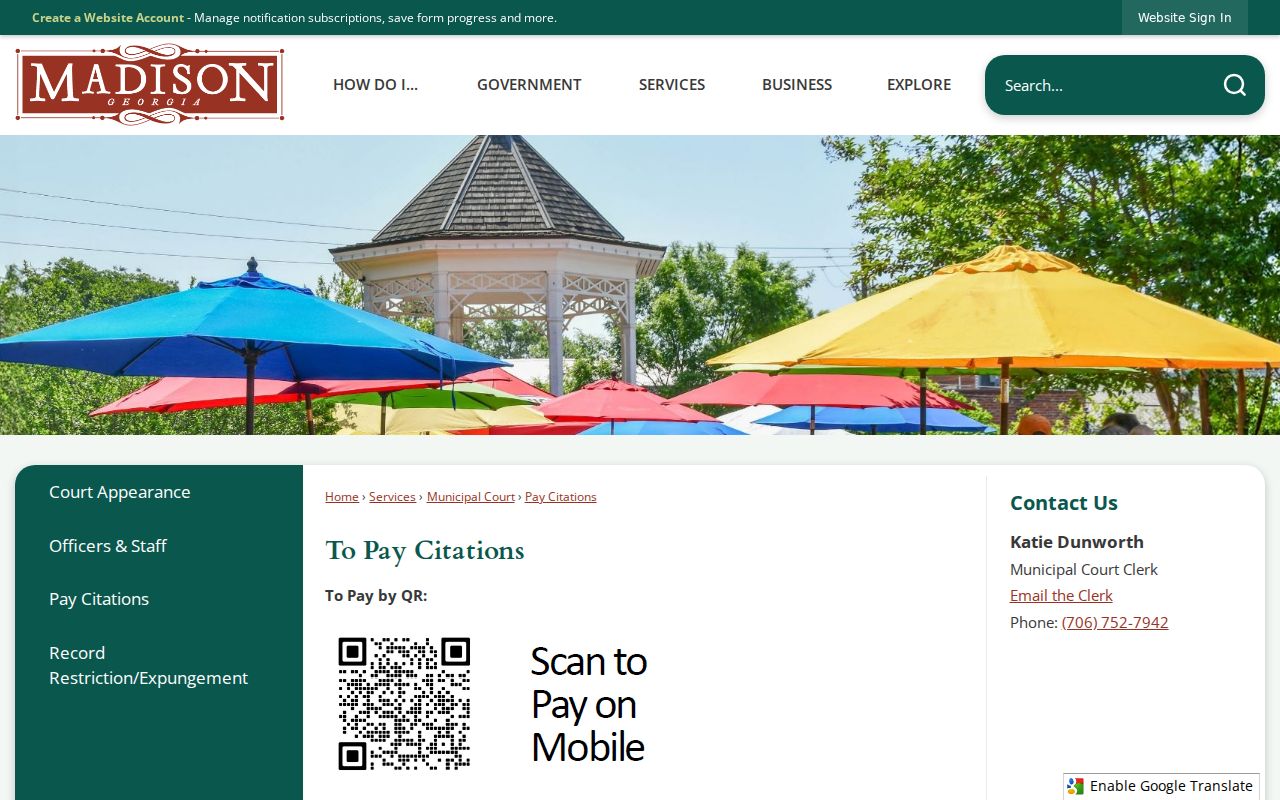
JusticeONE requires a citation number. Online and phone card payments carry a five percent fee. Mail accepts a money order or cashier’s check, while the counter also accepts cash. A successful search or payment can confirm that the supplied citation is in the payment system, but it does not expose every municipal file tied to a person.
Ask the clerk for the citation file, judgment, sentence, or status when those are the real goal. Be exact. “Is this citation payable?” differs from “What was the disposition?” A payment receipt does not replace a sentencing order, and a missing JusticeONE result does not prove that no city case exists.
Where Madison Records End Up
A Madison event can create records at three owners. Police keep the investigative report. The county detention center keeps booking and custody data. Municipal or Superior Court keeps the filed charge and outcome, depending on jurisdiction. Reported fingerprint-supported events and later dispositions may then enter the statewide criminal-history repository.
Record flow: Madison Police › Morgan County Courts › Georgia Bureau of Investigation, Georgia Crime Information Center
The flow is not instant or uniform. A recent report may exist before a charge is filed. A booking may appear before the court decides the case. Older local files may not be remotely indexed. For a complete answer, compare the source report with the court’s disposition rather than expecting one name search to join every layer.
Note: The Georgia criminal-disposition dashboard measures court reporting; it is analytics, not a public person-search system.
Madison Justice Offices Around Town
Madison was established and incorporated in 1809, grew as a stagecoach stop, and retains a National Register-listed downtown and residential historic district. That compact setting can make the justice offices seem like one system, but their files remain separate. Police reports and the Municipal Clerk are at 160 N. Main. Municipal hearings occur at 149 E. Jefferson. The Superior Court clerk is at 384 Hancock Street. The Sheriff and jail sit at 1380 Monticello Road.
A single arrest may require three contacts even when each office is only one part of the same event. Start with paperwork, not the nearest counter. Ask Madison Police for the city investigation, the jail for custody, and the named clerk for the judgment. This keeps a historic downtown records trip from becoming a sequence of wrong-office visits.
Public Access Rules
The Georgia Open Records Act generally covers existing public records held by Madison agencies. It does not force an office to create a new criminal-history compilation. A custodian may redact protected identifiers or withhold material under a stated exemption, including active-investigation information, juvenile material, victim-sensitive facts, medical data, and restricted or sealed records. A focused request is more useful than a demand for everything about a name.
The response period concerns the agency’s initial production, timetable, cost statement, exemption, or no-record reply. It is not a promise that a large file will be completed at once. The first 15 minutes of qualifying search and retrieval time are free under state law, and later labor may be charged at the rate of the lowest-paid qualified employee.
Key Statutes:
Georgia Open Records Act, O.C.G.A. §50-18-70 et seq. sets the public-access policy, response framework, fee rules, and exemptions.
O.C.G.A. §35-3-34 governs dissemination of Georgia criminal-history record information.
O.C.G.A. §35-3-37 governs inspection, correction, privacy, and record restriction.
Ask for the legal basis when access is denied. When an error appears in a statewide history, use the GCIC correction or self-review route rather than asking a city clerk to alter another agency’s record.